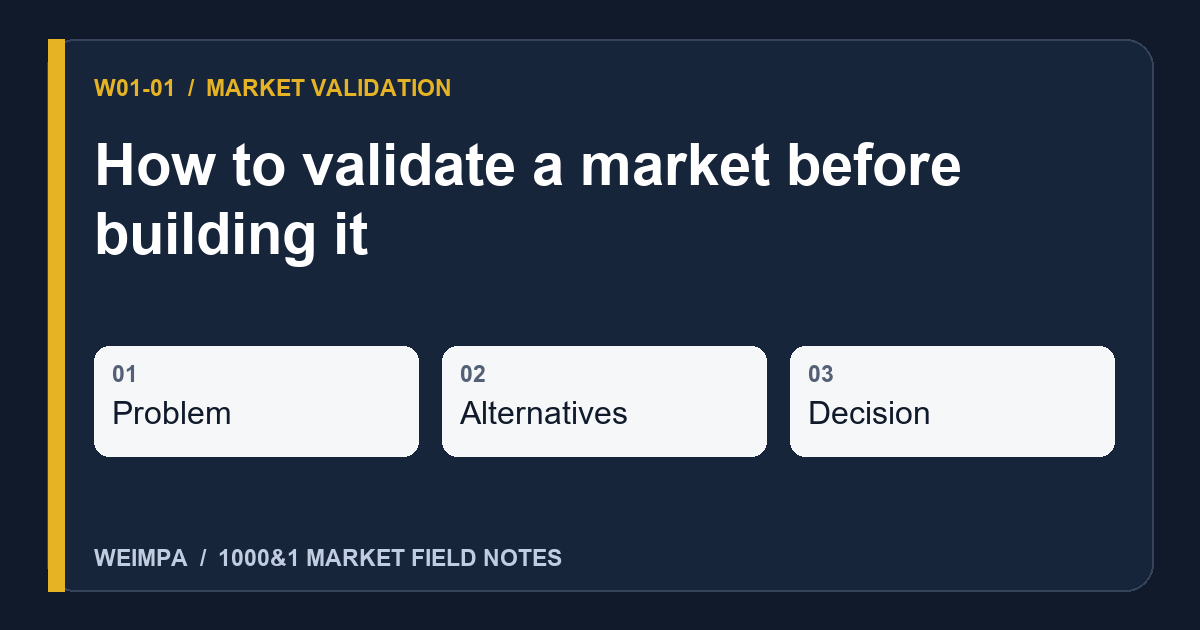
Set the gate before collecting evidence
Start with one buyer, one task and one geography. For a proposed specialist Market, a directory of available suppliers is not a demand test: the buyer may solve the task internally, buy an adjacent product or defer it. Put those routes in the same evidence register. For each, note the source, the observed behavior and what remains untested. The decision gate should identify the smallest scope that can be served with attributable information, not simply the largest industry label.
- Write a falsifiable sentence: this buyer group seeks this outcome in this geography and can reach these provider types.
- Look for independent traces of the problem and actual alternatives; record source dates and disagreements.
- Choose GO, NARROW or STOP with an explicit unresolved assumption and the next cheapest test.
Evidence-to-decision gate with stop conditions
| Decision field | Record or rule |
|---|---|
| Problem | name the task in the buyer's words before estimating supply. |
| Alternatives | document current workarounds, including doing nothing. |
| Decision | set a test that would change the verdict, not a decorative KPI. |
- 01Problem
- 02Alternatives
- 03Decision
Make the verdict reversible
A GO verdict authorizes a bounded test with an owner and a review date. NARROW removes unsupported segments while preserving the evidence that remains useful. STOP records why the present route is not justified and what observation would reopen it. This avoids calling a weak signal a failure of an entire industry. In the 1000&1 Launch Case model, the Decision Brief, risk register and selected route are distinct outputs; each can be revisited when a source or assumption changes.
To carry this decision forward, frame the pre-entry questions; compare adjacent opportunities; decide when a Launch Case is warranted.
A worked gate for a new specialist Market
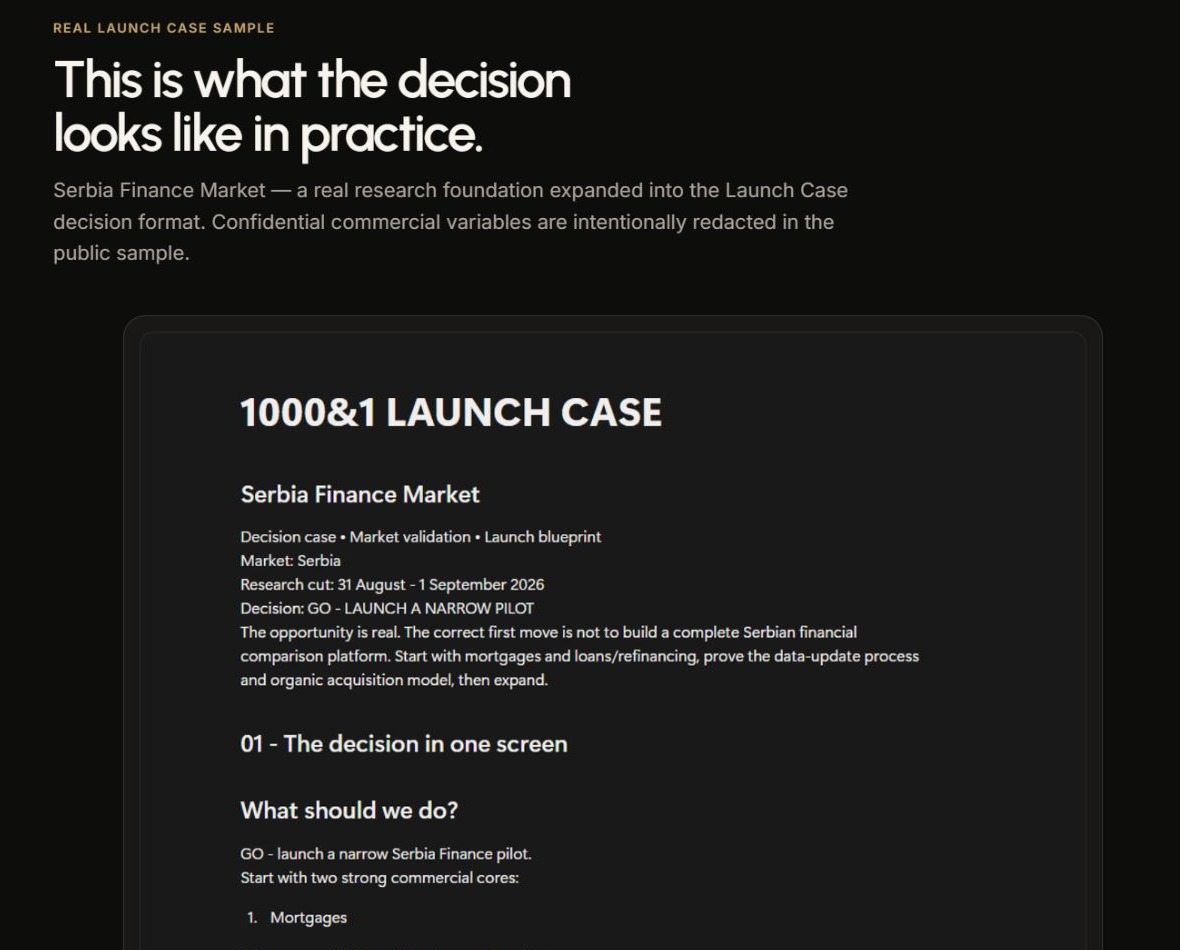
Imagine a proposed Market for a narrow software buying task. The team has public provider pages and a handful of relevant searches, but no evidence that the intended buyer is willing to compare those providers through a maintained map. The first verdict is NARROW: publish a small evidence-backed comparison of the specific task, seek direct buyer reactions, and hold adjacent categories. If buyers reject the comparison dimensions, revise the task; if sources cannot support a reliable map, stop the route. The gate protects the team from interpreting supply availability as buyer demand. Record the decision, owner, date and reopening condition in the same brief so the test remains auditable.
The output should also separate the evidence threshold from the implementation plan. A test can be worth running even when the full Market is not yet justified. If the buyer task is clear but source coverage is weak, assign a source audit before a public profile build. If source coverage is rich but the buyer task is speculative, seek buyer-side evidence before adding categories. This sequencing makes the same GO, NARROW and STOP labels operationally different and prevents “we have data” from substituting for “we have a buyer decision to support.”
Do not infer willingness from supply
If only supplier enthusiasm is visible, narrow the question. Search impressions can show discoverability after publication, but they cannot establish willingness to buy or a viable unit economy.
References and source notes
Original 1000&1 methodology reviewed and approved by the author. Public claims and historical measurements are bounded by the linked sources and dates.