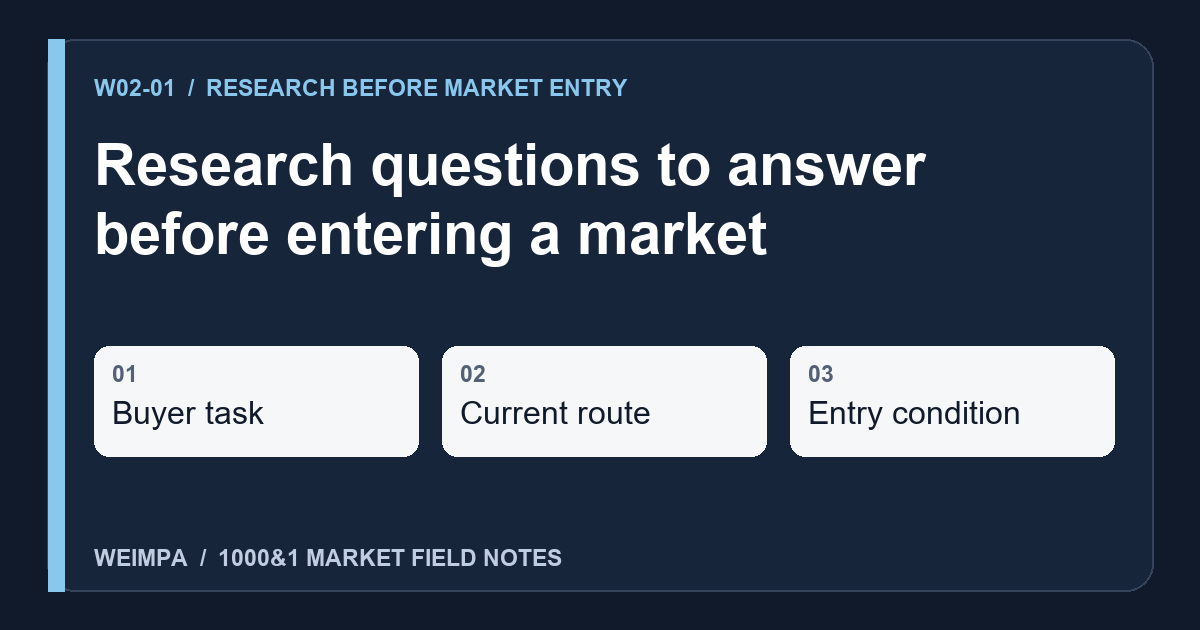
Seven-question pre-entry brief
| Decision field | Record or rule |
|---|---|
| Buyer task | what is the specific unmet or poorly served job? |
| Current route | how do buyers solve it without the proposed Market? |
| Entry condition | what evidence would justify first implementation? |
- 01Buyer task
- 02Current route
- 03Entry condition
Write questions that can change the entry decision
A pre-entry brief starts with the buyer group, territory and decision owner. It asks how buyers currently complete the task, what alternatives are reachable, which sources describe the supply, what economics are assumptions and what operating constraints would block a Market. Each question needs an output: a source table, comparison, sensitivity or test plan. Questions without a possible effect on entry can wait.
- Specify buyer group, geography, time horizon and the decision owner.
- Sequence questions from demand and alternatives to supply, economics and operational constraints.
- Name the output for each question: source table, comparison, risk or test plan.
Sequence evidence before commitment
Do not start with the broadest industry estimate. First establish the job and alternatives, then evaluate source coverage and the ability to maintain reliable participant records. A Launch Case uses a Decision Brief, competitor evidence, risk and sensitivity to compare routes. That is a practical model for a research brief because the conclusion can point back to a specific unanswered question rather than to a general feeling about the sector.
To carry this decision forward, use an evidence-to-decision gate; carry the result into a Market.
Convert the brief into research assignments
Assign each pre-entry question an evidence owner and an output format. A buyer-language question needs interview notes or attributable public examples; a provider boundary question needs inclusion cases; an economics question needs a sensitivity model with assumptions labelled. Order assignments so later work depends on earlier answers only when necessary. If the buyer task itself is still unclear, commissioning a detailed competitor spreadsheet is premature. A decision-led brief saves effort by showing which uncertainty is on the critical path and which interesting questions can safely remain open.
Park questions that cannot change entry
A research question with no possible effect on scope or investment can be parked. It may be interesting but does not belong on the critical path to a first Market.
References and source notes
Original 1000&1 methodology reviewed and approved by the author. Public claims and historical measurements are bounded by the linked sources and dates.