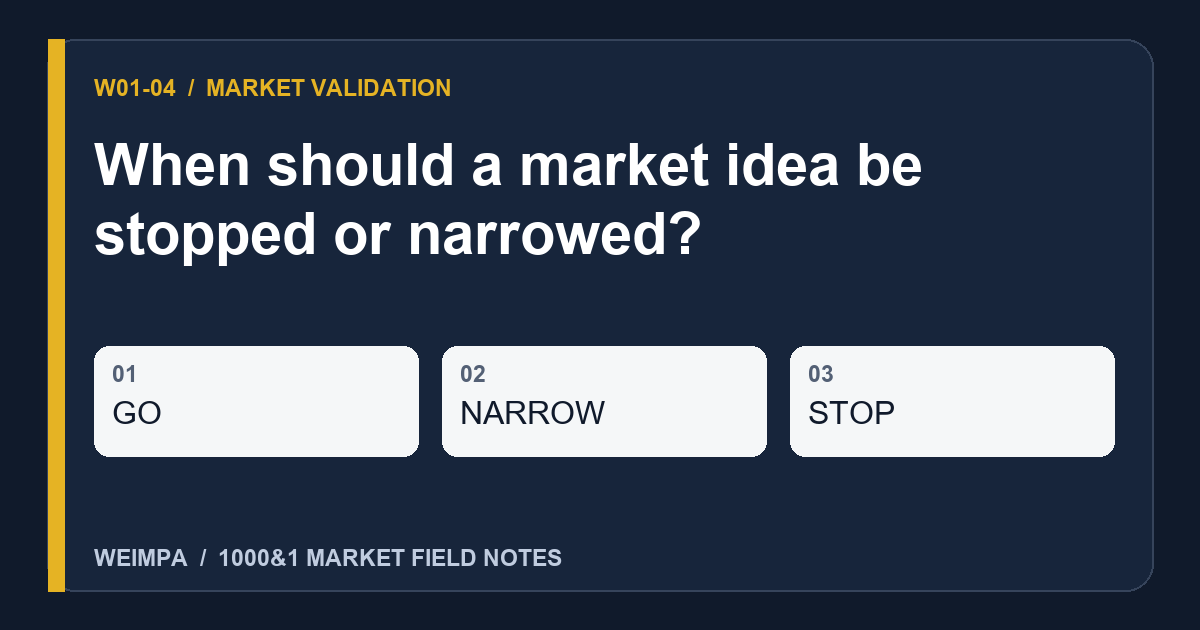
Distinguish a narrow path from a stopped thesis
Suppose broad supplier coverage is weak but one buyer task has credible alternatives and a source base. NARROW keeps that task and removes unsupported categories or geographies. STOP is appropriate when no route survives the agreed risk and evidence threshold. This decision should not be made by tallying favorable observations; one material contradiction, such as an unavailable supply route, may outweigh several weak signals.
- List evidence that supports the claim and evidence that contradicts it on the same page.
- Ask whether the weak signal belongs to the entire market or only one segment.
- Record what must change before the rejected scope can be reopened.
GO/NARROW/STOP decision table
| Decision field | Record or rule |
|---|---|
| GO | at least one coherent buyer task and testable implementation route survive review. |
| NARROW | a subset survives while broad supply or demand claims fail. |
| STOP | no defensible route remains at acceptable evidence and risk. |
- 01GO
- 02NARROW
- 03STOP
Record conditions for reopening
A stop memo is more useful when it names the missing fact, the cheapest way to test it and the owner who can revisit it. The public Micro Launch route already distinguishes GO DEEPER, REFINE and STOP at a first-pass depth. It does not certify a completed commercial case. Search Console silence from a young or unindexed property should never be used as the stop condition for underlying buyer demand.
To carry this decision forward, choose the depth of the next check; revisit the validation decision.
What a narrowed thesis preserves
A broad map may fail because most participant roles cannot be verified, while one use case has clear official sources and a real buyer comparison. NARROW preserves the use case and its evidence, removes the speculative roles and sets a review condition for expansion. STOP is different: even the narrow use case lacks a credible source or buyer path. Write both outcomes in language that another operator can apply. An unexplained “no” discards useful learning; an unexplained “yes” lets the original overbroad thesis return without review.
Do not mistake search silence for a stop signal
Do not turn absence of GSC clicks on a new site into proof that a market lacks demand. Indexing, page quality, age and query reporting are separate variables.
References and source notes
Original 1000&1 methodology reviewed and approved by the author. Public claims and historical measurements are bounded by the linked sources and dates.