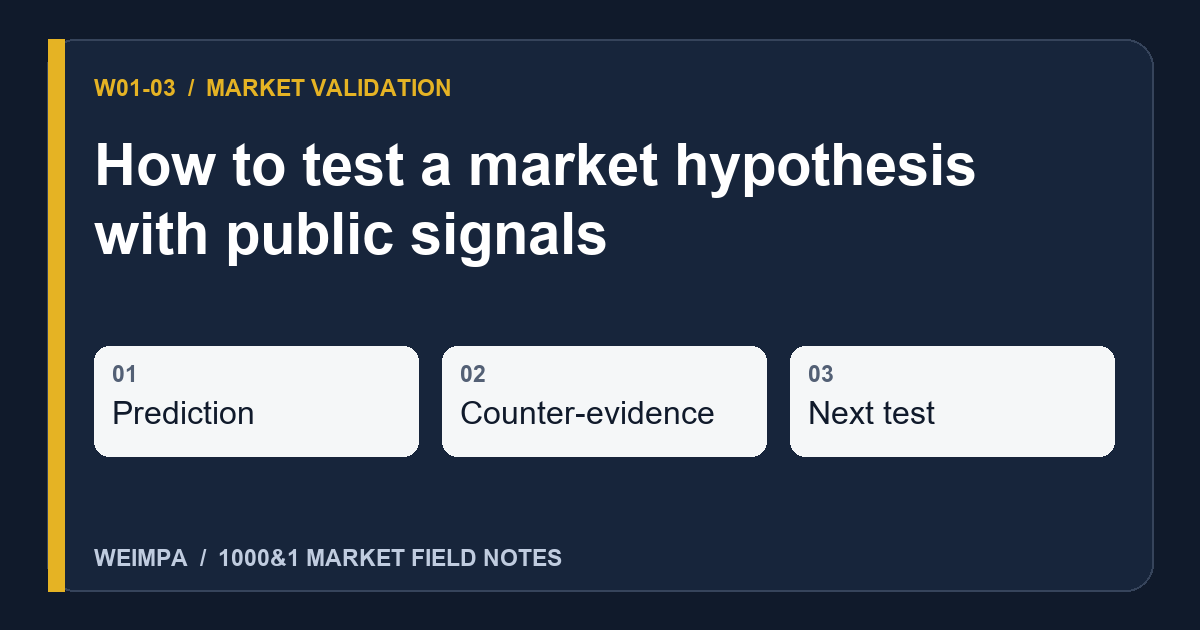
Hypothesis test card with falsifiers and source requirements
| Decision field | Record or rule |
|---|---|
| Prediction | a specific buyer task should surface in search or public provider language. |
| Counter-evidence | relevant buyers may use a different vocabulary or channel. |
| Next test | contact or observe the buyer process where public data is silent. |
- 01Prediction
- 02Counter-evidence
- 03Next test
Give the hypothesis a falsifier
“There is demand for this market” cannot fail a useful test. “Buyers comparing AI search tools look for engine compatibility and can find source-backed profiles” can be tested. The claim names the task, a visible route and the information the page must supply. A counter-signal might be queries that use a different vocabulary or pages that attract only named-product lookups. Record both before judging whether the Market boundary is right.
- Write one hypothesis per buyer task rather than a broad claim about an industry.
- Pair each predicted signal with a source and a counter-signal. Keep a dated capture of both.
- Decide in advance which result means continue, revise the scope or stop.
Separate the test surface from a result
Search1001 exposes category, capability, engine and integration routes. Those routes make distinct buyer tasks addressable, but their existence does not show that each task is already searched or that the answers are sufficient. Measure the actual page and query family; then inspect whether the visit can plausibly complete the task. A failed query match can call for a clearer page, a different category boundary or no new route at all.
To carry this decision forward, bound what public signals can prove; apply the final decision gate.
Design a small public-signal experiment
For a proposed technology Market, pick one buyer question, such as which products support a named engine. List the expected query family and the page intended to answer it. Audit that page's source-backed product relationships before measuring impressions. After a completed window, compare the query and page cuts, then inspect whether the landing page gives the promised answer. Relevant impressions with no useful page may call for enrichment; no reported query rows may call for a longer window or another evidence source. The experiment tests a route, not an entire industry.
A route is not proof of demand
A visible route is a test surface, not evidence that the route already attracts buyers. Validate the observed query family against the actual page before claiming a result.
References and source notes
Original 1000&1 methodology reviewed and approved by the author. Public claims and historical measurements are bounded by the linked sources and dates.