Compare routes on the same basis
An adjacent niche can look better merely because its sources are richer. Define the same buyer task, geography and time horizon for each option. Then compare signal quality, reachable alternatives, distinctiveness and maintenance burden. Put confidence beside each assessment; missing evidence is not a zero score. The point is to expose what would have to be true for one route to win.
- Define the same buyer task, supply boundary and geography for each option.
- Compare signal quality, reachable alternatives, differentiation and operating feasibility.
- Run a sensitivity check: would a reasonable change in one assumption reverse the choice?
Use a tie to design the next test
If a different weighting changes the winner, commission evidence for the decisive dimension instead of averaging away the conflict. The Launch Case model records selected and rejected routes with reasons. A first Market comparison should do likewise, including the reason a tempting larger segment was postponed. The output is a bounded route and a falsifiable next step, not a decorative ranking of industries.
To carry this decision forward, validate the selected route; choose the first Market.
Weighted comparison without invented market-size figures
| Decision field | Record or rule |
|---|---|
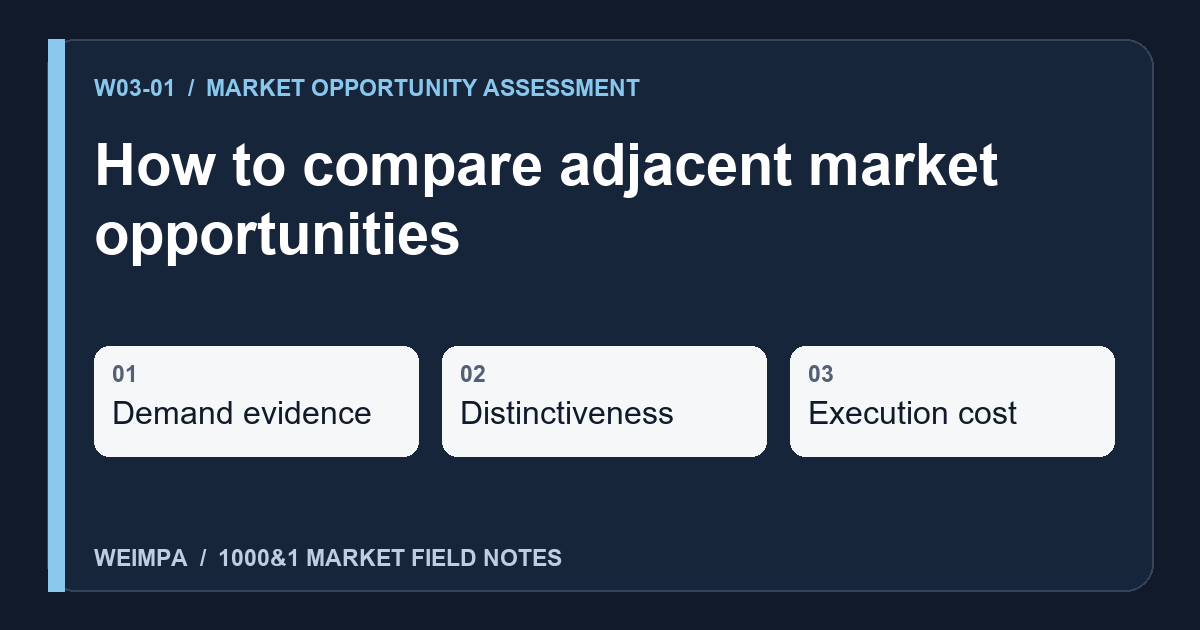
| Demand evidence | directly observed signals and their limitations. |
| Distinctiveness | why this Market would help a buyer decide. |
| Execution cost | source, update and distribution work required. |
- 01Demand evidence
- 02Distinctiveness
- 03Execution cost
Handle unlike source coverage
One candidate territory may have rich public documentation; another may have stronger anecdotes from buyers but sparse participant data. Do not assign the second a low market score simply because its evidence is less convenient. Mark confidence and identify the missing comparison dimension. A short buyer test or sample source audit can be cheaper than building two full Markets. When the result remains tied, preserve both routes in the decision memo and defer a final selection until the decisive evidence is available.
Do not force a winner from missing data
Do not force a winner when both options lack comparable buyer evidence. The correct result can be a smaller test for each or a deferred decision.
References and source notes
Original 1000&1 methodology reviewed and approved by the author. Public claims and historical measurements are bounded by the linked sources and dates.