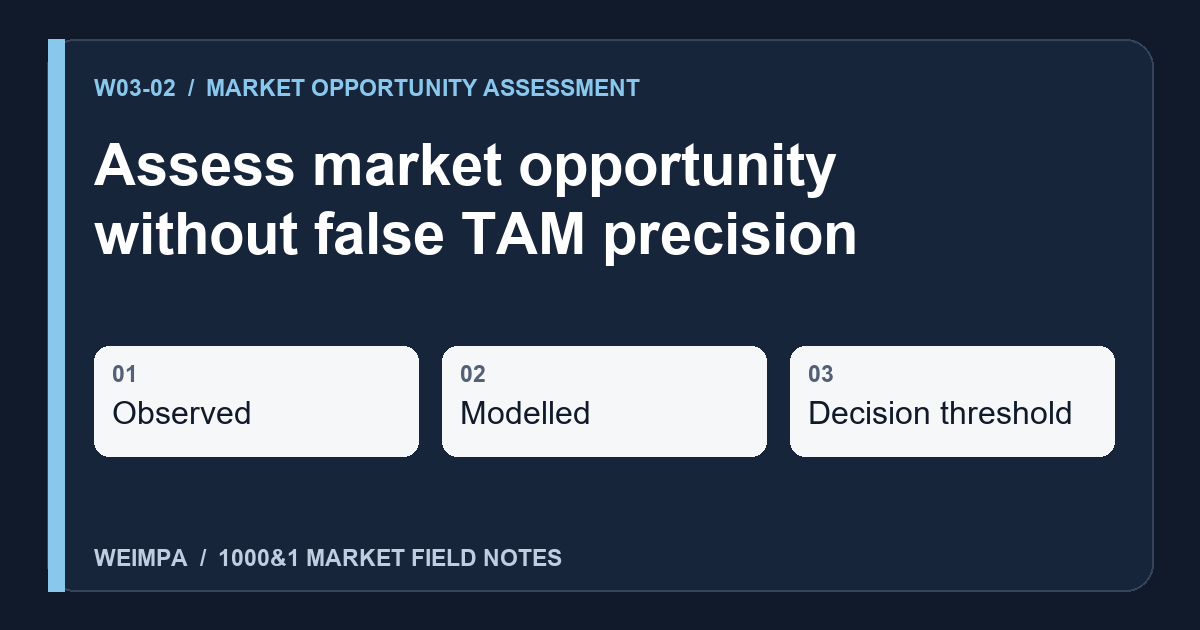
Opportunity evidence stack and sensitivity bands
| Decision field | Record or rule |
|---|---|
| Observed | public buyer or supplier evidence with date and coverage. |
| Modelled | adoption, conversion and price ranges, clearly labelled. |
| Decision threshold | what minimum result justifies the next test? |
- 01Observed
- 02Modelled
- 03Decision threshold
Build the opportunity from reachable decisions
A national market total says little about the first buyers a Market can serve. Start with a segment, a decision event and a reachable territory. Record observed buyer or supply signals separately from adoption, price and conversion assumptions. A wide range is honest when the source base is thin; a precise point estimate can conceal the uncertainty that actually controls the investment.
- Start with the actual buyer segment and decision event, not a national industry total.
- Separate observed volume from model inputs such as adoption and price.
- Identify the assumption whose variation most changes the decision.
Find the assumption that matters
Vary one model input at a time and note where the next action changes. If modest conversion changes erase the case, test conversion before adding more provider profiles. The public Launch Case includes commercial sensitivity as a distinct component of the Decision Brief. Its role is to guide a bounded research choice, not to turn a spreadsheet outcome into a measured traffic, revenue or demand claim.
Stress-test the route before the total
If the proposed Market serves a narrow buyer segment, the decision may depend more on whether useful sources can be maintained than on a large top-down revenue number. Build a small range for reachable buyers and compare it with the cost of verified profiles and ongoing corrections. Mark every adoption and price value as modelled. If a modest change in source cost or buyer uptake reverses the conclusion, that is the next research priority. A more precise industry TAM will not repair the decisive unknown.
Use ranges when the evidence is thin
A wide range is not a defect if the underlying evidence is thin. Giving a narrow number without direct measurements is the defect.
References and source notes
Original 1000&1 methodology reviewed and approved by the author. Public claims and historical measurements are bounded by the linked sources and dates.