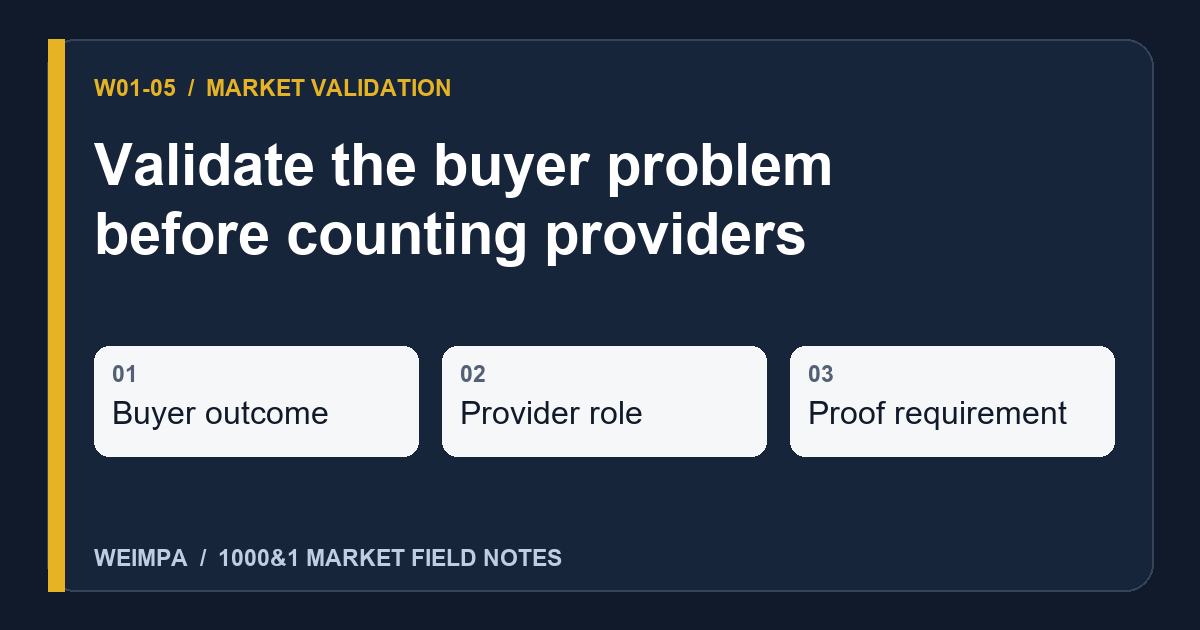
Begin with the work buyers already do
If a buyer needs to choose a tool, the relevant market may include in-house work, consultants and adjacent products, not only vendors carrying one category label. Collect the trigger, constraints and current workaround before assigning provider roles. A large provider inventory that cannot answer the buyer's comparison question adds maintenance cost without improving the decision.
- Capture the task, trigger event and constraints from buyer-side language.
- Identify competing routes to the outcome, including internal work and adjacent products.
- Only then count and qualify providers within the selected boundary.
Problem-to-offer evidence chain
| Decision field | Record or rule |
|---|---|
| Buyer outcome | what changes when the task is solved? |
| Provider role | which part of that outcome can this participant deliver? |
| Proof requirement | what public evidence supports that role? |
- 01Buyer outcome
- 02Provider role
- 03Proof requirement
Test the route from problem to offer
The Game Growth Market presents company profiles; Search1001 organizes technology through categories and capabilities. These are different supply structures. For either, a useful validation check asks whether the profile fields let a buyer distinguish routes to the same outcome. If a Market category depends on the provider's self-description rather than a buyer-relevant capability, revise the taxonomy before increasing coverage.
To carry this decision forward, set the Market boundary; test the buyer problem first.
A provider count can point the wrong way
A market with many visible providers may still be hard for buyers to navigate if each listing uses different vocabulary and none documents the buyer-critical constraint. Conversely, a small set can justify a useful Market if each route is distinguishable and the problem is frequent enough to merit maintenance. Test a sample of provider records against one actual buyer question. If the comparison cannot be completed from attributable fields, adding fifty more logos will not solve the research problem. Improve the category rule or collect a better source first.
A provider count is not buyer demand
If buyer language and provider taxonomy do not align, repair the scope before building more pages. A prettier list does not resolve the mismatch.
References and source notes
Original 1000&1 methodology reviewed and approved by the author. Public claims and historical measurements are bounded by the linked sources and dates.