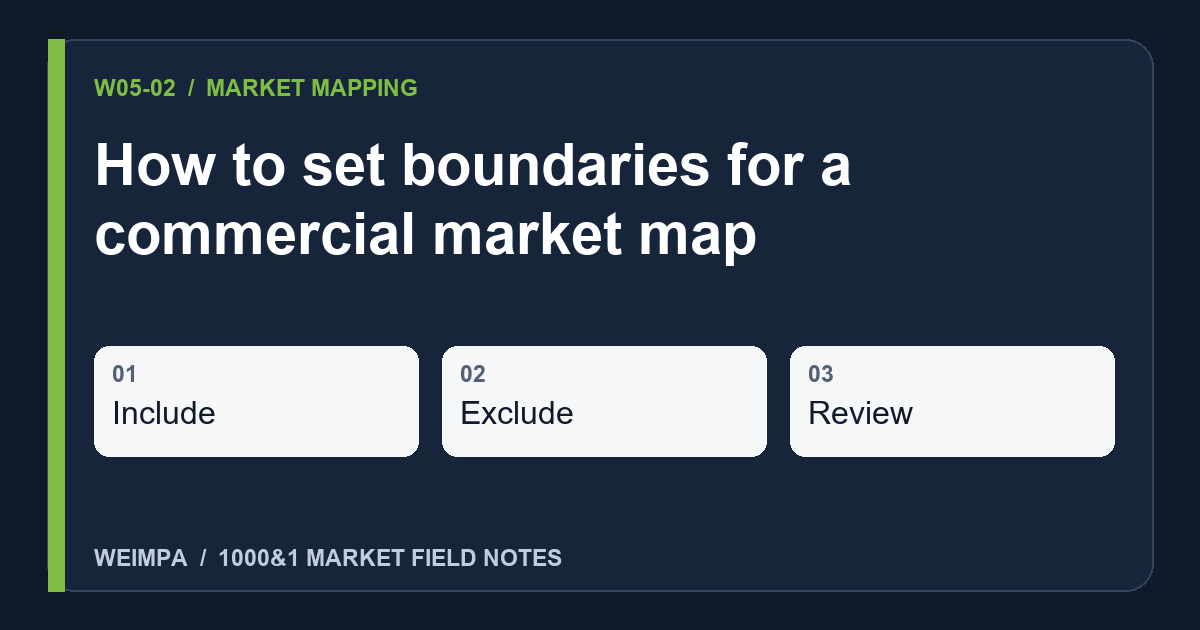
Write cases at the boundary
A rule needs a positive example, a clear exclusion and an adjacent case requiring review. For an AI search technology Market, a product with a documented search capability may qualify; an unrelated general marketing tool should not enter because it uses the word “AI.” An adjacent analytics product needs inspection of the actual buyer task and capability. Record the evidence behind each ruling so later reviewers can apply the same rule.
- Write the buyer task and minimum participant role in plain language.
- Test the rule on obvious inclusions, obvious exclusions and difficult adjacent cases.
- Version the rule; preserve why a disputed entity was accepted or rejected.
Boundary rule with positive, negative and review cases
| Decision field | Record or rule |
|---|---|
| Include | the offering directly supports the selected buyer task. |
| Exclude | a neighboring category without a relevant capability or route. |
| Review | ambiguous scope needs attributable evidence and a named decision. |
- 01Include
- 02Exclude
- 03Review
Separate scope from judgment of a company
Exclusion says the Market does not answer a particular question about that participant. It is not a negative quality verdict. Search1001's public scope and profile guidance illustrate the distinction between a territory definition and checking a vendor claim. When the Market boundary changes, version the rule and identify affected categories and routes. Otherwise old and new profiles may silently follow different standards.
To carry this decision forward, place the rule in the data model; audit participant inclusion.
An inclusion review in three cases
Start with an obvious product whose official materials show the selected buyer capability. Include it and cite the source. Next take a general service provider using a broad market keyword but offering no relevant capability; exclude it with the rule that failed. Finally take an adjacent product with partial evidence; hold it for review and specify what document would settle the case. These three outcomes make the boundary teachable. A future operator can apply the same test without relying on the original editor's intuition.
Exclusion is a scope decision
A boundary is not a claim that excluded businesses have no value. It states which question this Market is designed to answer.
References and source notes
Original 1000&1 methodology reviewed and approved by the author. Public claims and historical measurements are bounded by the linked sources and dates.