Read property totals as the top of a stack
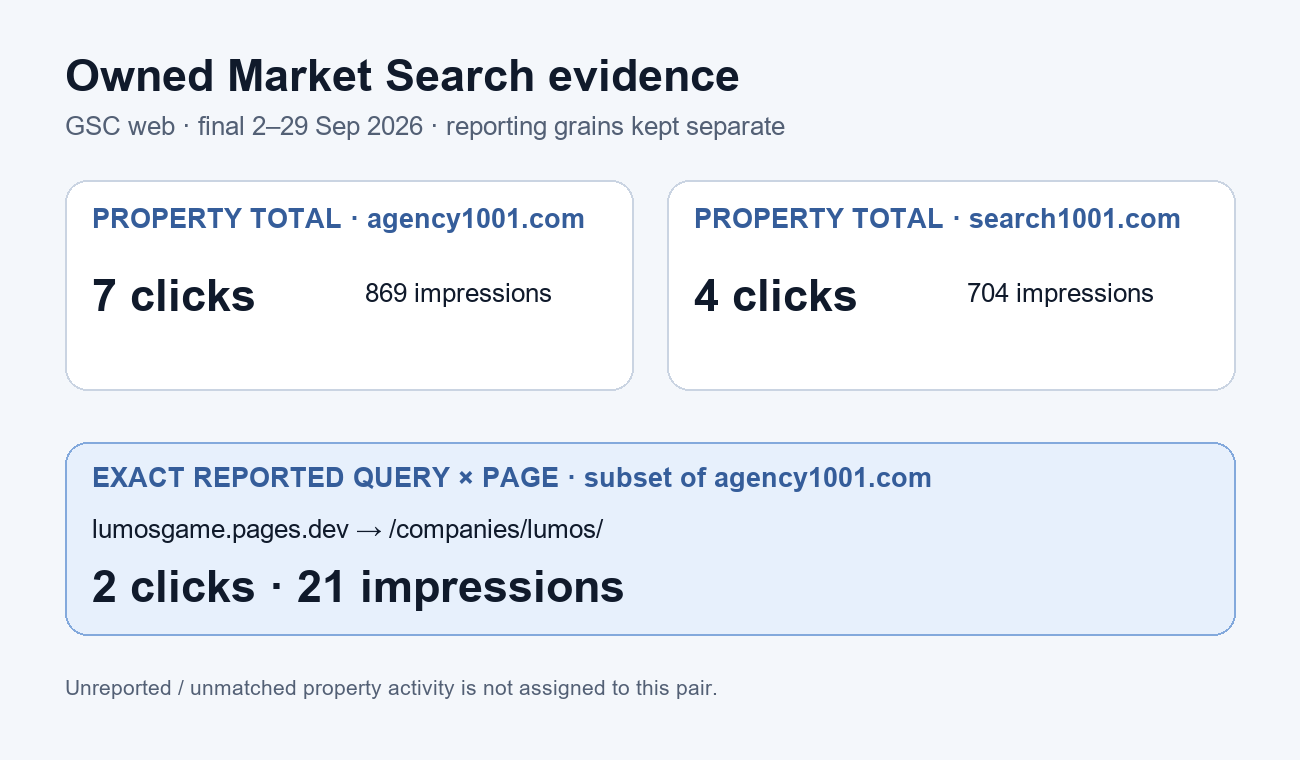
For the completed 2–29 September 2026 GSC window, agency1001.com reports 7 clicks and 869 impressions, while search1001.com reports 4 clicks and 704 impressions at property level. These totals establish early reported Search activity for two owned Markets. They do not tell us that all activity went to participant profiles, or that a reported click became a commercial lead.
- State the property, search type and inclusive date window.
- Show exact example rows without treating them as the whole property.
- Keep suppressed or unmatched query data unassigned.
Two-property GSC evidence table with limits
| Decision field | Record or rule |
|---|---|
| Game Growth Market | property aggregate 7 clicks and 869 impressions. |
| AI Search Market | property aggregate 4 clicks and 704 impressions. |
| Example routes | Lumos query×page 2/21; PageOptimizer Pro page 1/2; Scalenut page 1/1. |
- 01Game Growth Market
- 02AI Search Market
- 03Example routes
Use rows without overstating coverage
A query-by-page row can support an exact attribution claim for that pair. The Lumos row reports 2 clicks and 21 impressions; it is a subset, not a reconciliation of the property total. Google may omit query rows for privacy or reporting thresholds. Compare page and query cuts as separate views, retain the export window, and leave the unassigned remainder unassigned.
To carry this decision forward, understand the profile discovery path; separate totals from attributed rows; build the measurement worksheet.
A two-property evidence reading
Agency1001 and Search1001 report different property totals and different public Market structures. Put the four property metrics in a table with the same completed period and search type, then keep profile-specific rows beneath it rather than adding them to a total again. PageOptimizer Pro and Scalenut each have page-level observations in Search1001, but those are page cuts, not query-by-page attribution. The distinction matters when an article names a particular participant. Early data can justify a measurement practice without proving that one Market design outperforms another.
When the same report is viewed by page and by query, totals may not reconcile by simple addition because dimension cuts and privacy suppression differ. Preserve the raw export and request parameters in the evidence package. In the public article, quote only values whose reporting level is explicit. A reader should be able to tell which numbers describe an entire property, which describe a page and which describe a specific query-page pair without reverse-engineering the table.
Property totals are not profile totals
GSC can anonymize queries and aggregate cuts can differ. Do not sum unlike cuts or attribute property-level clicks to a visible query without a matching query×page row.
References and source notes
- First-party GSC Search Analytics export, web, dataState=final, 2–29 September 2026; exact rows retained in the private evidence package
- Google Search Analytics API: dimensions and data limits
- Game Growth Market
- Search1001 Market
Original 1000&1 methodology reviewed and approved by the author. Public claims and historical measurements are bounded by the linked sources and dates.