
Choose the correct reporting grain
Property totals answer how much reported Search exposure a site had. Page totals answer which URL received it. Query totals describe reported language, while query-by-page rows connect a specific phrase to a specific URL. A claim about a named profile needs the last grain; a property number cannot be allocated to that profile by intuition.
- Record which dimension produced each number.
- Match query and page in the same row before claiming that query drove the profile.
- Reconcile visible row sums with property totals as a coverage note, not as a forced allocation.
Query×page versus property-level reconciliation
| Decision field | Record or rule |
|---|---|
| Property | total observed search performance for the verified site. |
| Page | the URL received observed impressions or clicks. |
| Query×page | an exact visible pair supports the narrowest claim. |
- 01Property
- 02Page
- 03Query×page
Reconcile without forcing equality
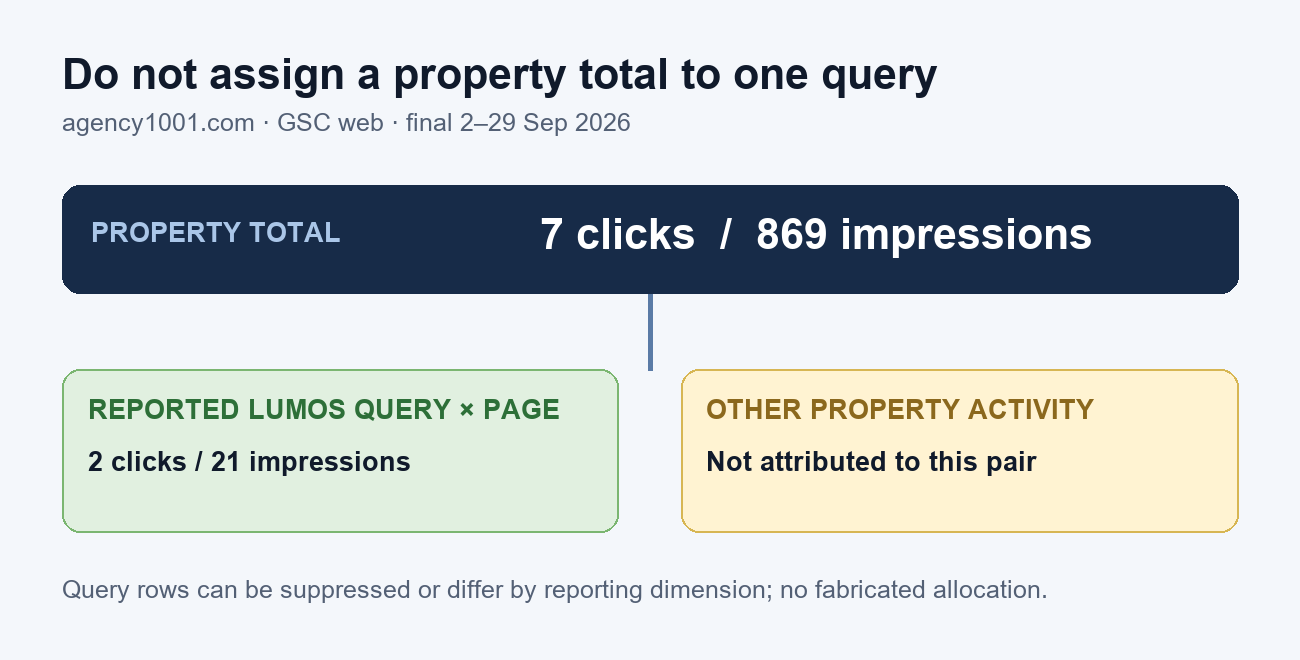
The agency1001.com Lumos pair shows 2 clicks and 21 impressions in the owned export. The property total is 7 clicks and 869 impressions. The difference is not a hidden Lumos estimate: query reporting can be incomplete, and dimensions aggregate differently. Preserve the exact date window and search type beside each table. This protects a strong small observation from being diluted by an inflated attribution claim.
To carry this decision forward, inspect the disclosed property totals; measure routes and tasks.
A reconciliation note for an editorial claim
If an article says “the Lumos profile received two clicks for this reported query,” cite the query-by-page row. If it says “the Game Growth Market property received seven clicks,” cite the property row. The two statements can coexist, but the five remaining property clicks cannot be assigned to Lumos. Likewise, a page total for a Search1001 product does not reveal which query generated it. Writing the reporting grain into the sentence is a small editorial step that prevents a large attribution error.
This also affects visual design. A diagram should show the property total above the page and query-by-page layers, with an unallocated remainder rather than an arrow implying that every click flows to the featured profile. Labels such as “reported pair” and “property total” are more useful than an impressive-looking funnel. The owned data is strongest when its small, precise observation remains small and precise.
The unallocated remainder stays unallocated
GSC may suppress queries. Never fill the missing portion with guessed brand terms, participant names or buyer intent.
References and source notes
- First-party GSC Search Analytics export, web, dataState=final, 2–29 September 2026; exact rows retained in the private evidence package
- Google Search Analytics API: dimensions and data limits
- Game Growth Market
- Search1001 Market
Original 1000&1 methodology reviewed and approved by the author. Public claims and historical measurements are bounded by the linked sources and dates.