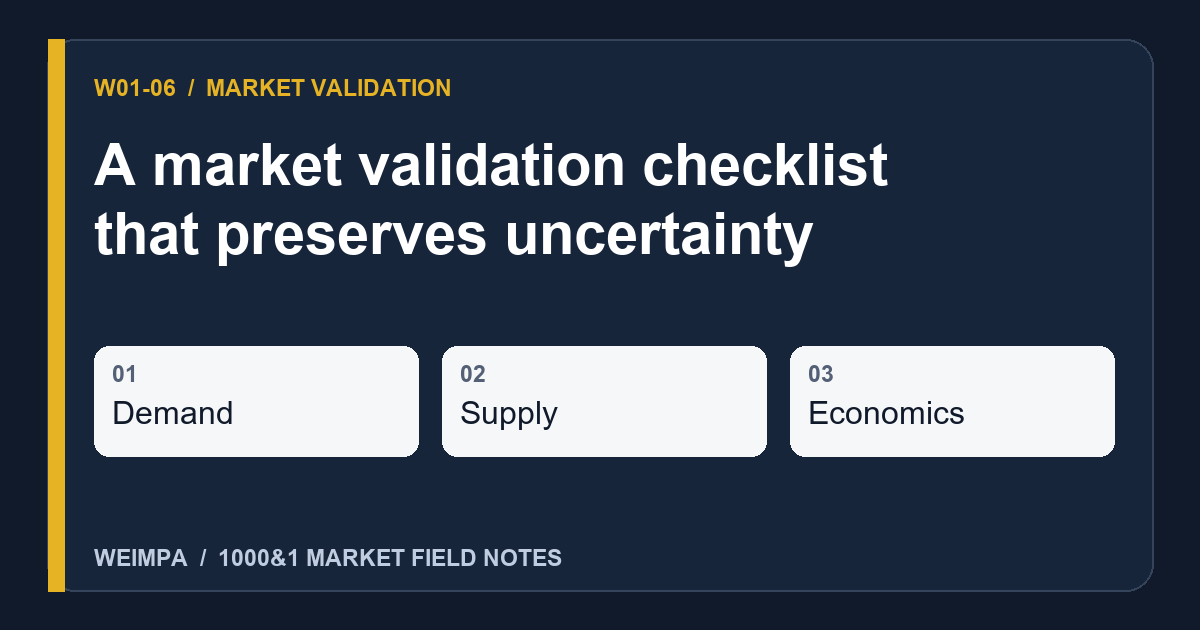
Keep unknowns visible in the register
A checkbox labelled “demand validated” hides the difference between a measured observation and an analyst's assumption. Write the decision question above the checklist. For each answer, capture a source, a date, confidence and the effect on GO, NARROW or STOP. A disputed value should retain both observations until reviewed; an empty value should remain empty rather than inheriting the most optimistic estimate.
- State one commercial decision the validation is supposed to support.
- Record the strongest supporting and conflicting observation for each question.
- Assign the next action and owner to unresolved assumptions before changing status.
Review the evidence as a package
The public Launch Case sample separates evidence, commercial sensitivity, a risk register and a Decision Brief. Use that separation to ask whether an unresolved assumption can reverse the selected route. If yes, commission the smallest next test. If no, record why it is safe to proceed within a narrower scope. A completed checklist authorizes a decision under stated uncertainty; it does not create product-market fit.
To carry this decision forward, build a source register; turn the register into a verdict.
Five-question evidence register with confidence classes
| Decision field | Record or rule |
|---|---|
| Demand | whose task is visible, and where? |
| Supply | are relevant alternatives reachable and distinguishable? |
| Economics | which variables remain assumptions rather than measured facts? |
- 01Demand
- 02Supply
- 03Economics
Review the five questions as a decision
Demand, alternatives, reachable supply, operating cost and unresolved risk should each have a source and an explicit state. The checklist is complete only when the decision owner can see which unknown could reverse the next commitment. A high-confidence supplier identity and a low-confidence conversion assumption should not average into “medium confidence.” Ask what new observation would change the decision and when it can be obtained. The answer may justify a small test, a narrower scope or a hold. This is the purpose of preserving uncertainty rather than hiding it behind a percentage score.
A checklist cannot certify fit
This checklist does not certify product-market fit. It decides whether a bounded next test is justified with the evidence available today.
References and source notes
Original 1000&1 methodology reviewed and approved by the author. Public claims and historical measurements are bounded by the linked sources and dates.