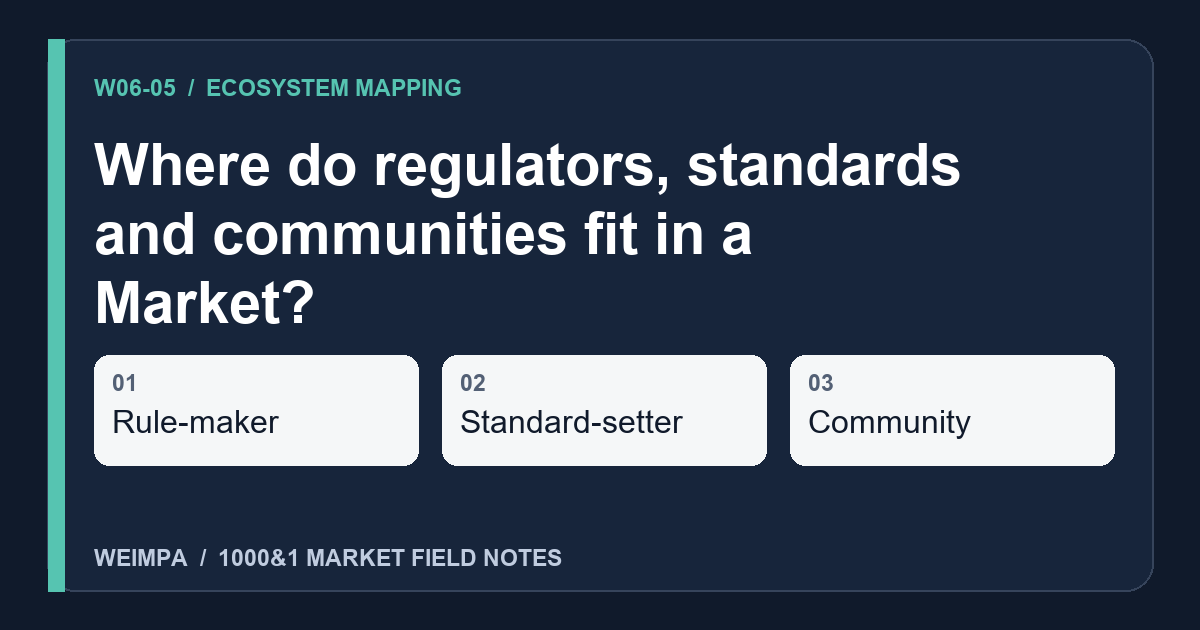
Include context actors for a reason
Regulators, standards bodies and communities can shape a commercial ecosystem without being direct providers. Add them when their rule, specification or convening role changes the buyer's feasible options. Label them as context actors so they are not compared against products in a vendor grid.
- State the specific buyer decision affected by the noncommercial actor.
- Link a current official source or attributable public record to the relationship.
- Place the actor in context instead of mixing it into provider rankings.
Trace influence without inventing transactions
A public standard can explain an interoperability requirement, but its existence does not prove that each listed vendor implements it well. A community mention can signal attention, not revenue. Use a separate relationship type and source for the influence. This keeps the ecosystem view rich enough to explain constraints while preserving the Market's narrower participant inclusion rule.
To carry this decision forward, keep context actors separate from offers.
Context-actor inclusion framework
| Decision field | Record or rule |
|---|---|
| Rule-maker | changes eligibility, disclosure or compliance. |
| Standard-setter | defines comparable requirements or terminology. |
| Community | reveals usage, concerns or buyer vocabulary. |
- 01Rule-maker
- 02Standard-setter
- 03Community
Separate influence from supply
A standards body can define an interoperability requirement and a community can shape terminology, yet neither is a vendor for the buyer's immediate purchase. Store their influence as context relationships with sources. A product claiming compliance needs its own evidence; the standard's existence does not verify that claim. In a buyer-facing view, context actors can explain why options differ while the competitive set stays limited to actual alternatives. This avoids a visually impressive but conceptually confused ecosystem diagram.
The context layer needs its own review cadence because standards and rules can change independently of vendor offerings. A dated source and named relationship owner make the influence visible without implying endorsement or participation in a transaction. If no buyer decision depends on the actor, leave it out of the public map and keep it in internal research notes.
Influence is not a vendor offer
Do not imply endorsement, certification or legal compliance unless the source directly supports that exact claim.
References and source notes
Original 1000&1 methodology reviewed and approved by the author. Public claims and historical measurements are bounded by the linked sources and dates.