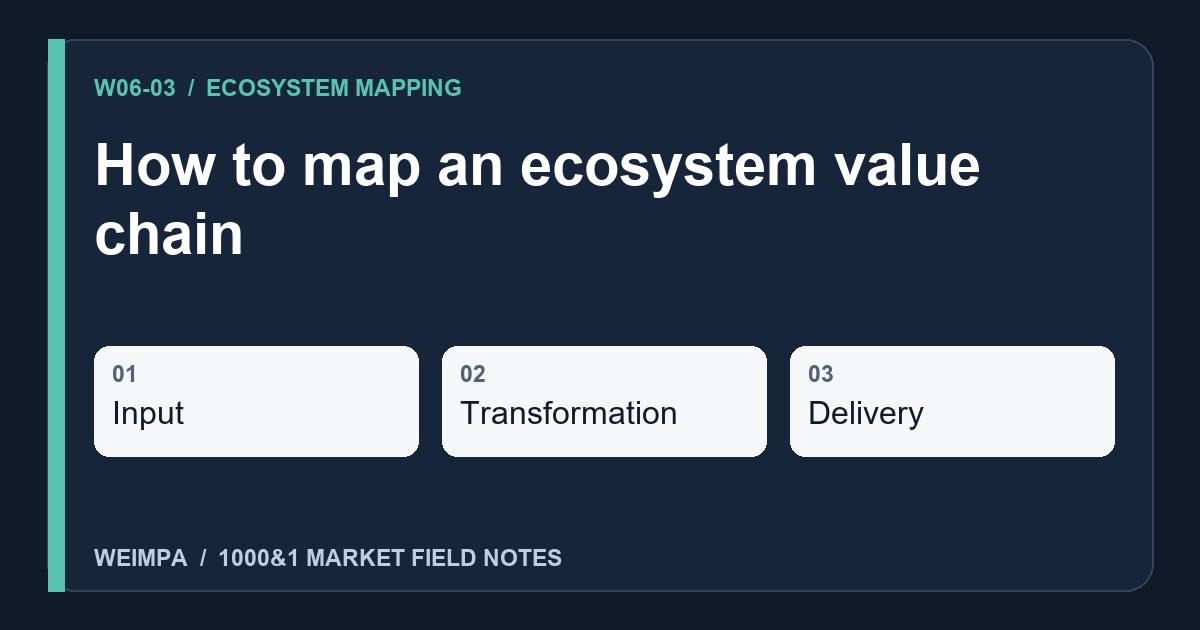
Map the path to the buyer outcome
Start at the input that enables the service, trace the product or intermediary roles and end at the buyer's decision or use. Mark where a handoff, standard or platform dependency can block the route. A value chain is useful when it explains a constraint that a plain competitor list cannot show.
- Start from the buyer's completed task and work backward.
- Place each actor at the step where it creates or transfers value.
- Identify bottlenecks and missing handoffs with evidence, not speculation.
Input-to-buyer chain with dependency checks
| Decision field | Record or rule |
|---|---|
| Input | resource, data or capability entering the chain. |
| Transformation | activity that makes the input useful. |
| Delivery | route through which the buyer receives the outcome. |
- 01Input
- 02Transformation
- 03Delivery
Find the weak link with sources
Search1001's engine and integration routes illustrate how a product can depend on other technical layers. A route listed on a page establishes a public claim about compatibility or integration; it does not prove deployment quality for every customer. Capture the exact source for each link and flag unverified operational dependencies. This makes the diagram a research tool rather than a fictional business map.
To carry this decision forward, compare the two map purposes.
Test a chain for missing dependencies
Draw the input, enabling technology, intermediary, offering and buyer task. For each arrow, ask what public evidence supports the relation and what would break if it disappeared. A product may advertise compatibility with an engine, but an actual deployment can depend on version, configuration or contract terms not visible publicly. Mark those as checks for the buyer. The value-chain map is strongest when it exposes a dependency or handoff that changes the decision, rather than merely adding more boxes to a diagram.
Public compatibility is bounded
The chain may branch and loop. Do not force an overly linear drawing when actual buyer journeys differ by segment.
References and source notes
Original 1000&1 methodology reviewed and approved by the author. Public claims and historical measurements are bounded by the linked sources and dates.