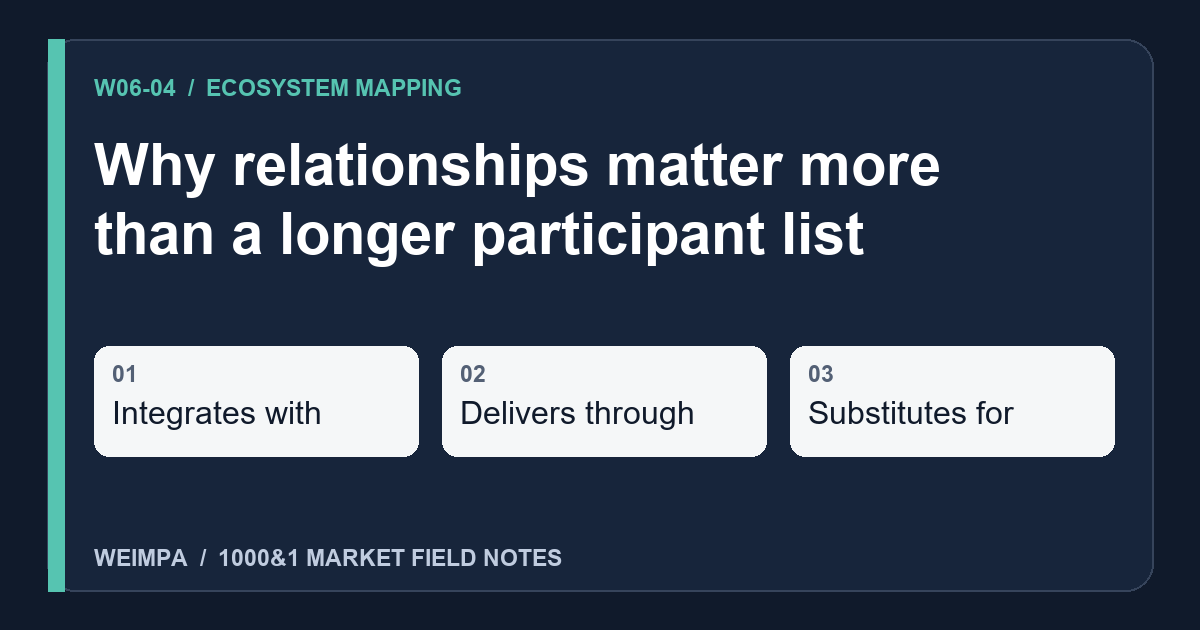
Record the edge and its evidence
A longer participant list gives no answer about who supplies, integrates, competes with or depends on whom. Store each relationship as a separate assertion with source, date, direction and confidence. One entity can hold several roles, and a change in one edge should not rewrite its identity record.
- Select only relationship types that affect the buyer task.
- Require a dated source for both endpoints and the asserted link.
- Show unknown relationships as unknown; do not treat silence as absence.
Relationship evidence table
| Decision field | Record or rule |
|---|---|
| Integrates with | a documented technical or product connection. |
| Delivers through | an evidenced channel or intermediary. |
| Substitutes for | alternatives for the same buyer outcome. |
- 01Integrates with
- 02Delivers through
- 03Substitutes for
Show the consequence of a changed edge
If an integration is retired, update the routes and profiles that rely on it. If a category membership is disputed, retain the source history while review is open. Search1001's visible category and integration paths make these consequences concrete: a buyer arriving through an integration task needs current evidence of that relation, not just the product name. Relationship maintenance is part of Market operation.
To carry this decision forward, model the underlying relationship.
A relationship update workflow
A source shows that a product has added an integration. The operator records the claim, date and exact documentation link; checks whether the relation fits the Market boundary; updates the integration route; and reviews the product profile and comparison pages that reference it. If documentation later disappears, the relation moves to needs-review rather than silently remaining current. This workflow differs from adding the company name to a list. The valuable unit is the maintained, attributable edge between records.
A name is not a relationship
A graph visual can suggest certainty beyond the underlying data. Its legend should distinguish observed, inferred and unverified edges.
References and source notes
Original 1000&1 methodology reviewed and approved by the author. Public claims and historical measurements are bounded by the linked sources and dates.