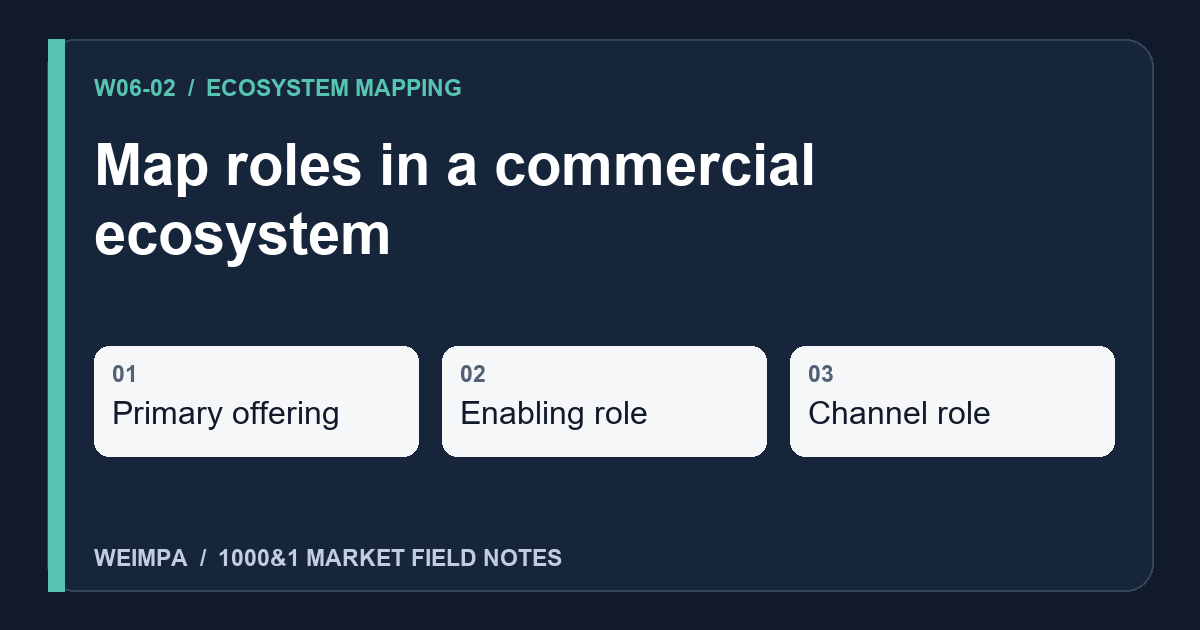
Role matrix with multi-role assignment
| Decision field | Record or rule |
|---|---|
| Primary offering | what the buyer can obtain directly. |
| Enabling role | what the organization supplies to another participant. |
| Channel role | how it reaches or serves buyers. |
- 01Primary offering
- 02Enabling role
- 03Channel role
Assign roles per activity, not per logo
A participant may build technology, distribute another product and provide implementation services. One fixed “vendor type” can hide this. Use a role matrix keyed to the value-chain activity, with evidence for each assignment and an explicit unknown state. A buyer comparing products and an analyst studying the ecosystem may need different views of the same entity.
- Choose roles based on the value chain relevant to the buyer task.
- Allow several roles when separate sources support them.
- Retain the source and time for each role so changes are reviewable.
Review multi-role conflicts
In a technology Market, an integration partner may also compete with the integrated product. That is not a data error; it is a relationship that needs a time and context. Keep the participant identity stable while role edges change. Avoid inferring a commercial partnership from a shared mention or a logo: a public integration page and a verified partner claim carry different meanings.
To carry this decision forward, review participant eligibility; choose the map's unit of analysis.
A multi-role participant example
A technology company may publish a product, integrate another platform and offer implementation services. Each role answers a different question and may have a different source. The Market profile keeps one entity identity while its role matrix records three assertions. If the integration ends, only that relation is retired. A fixed single “company type” would either hide the change or force duplicate profiles. Explicit multi-role assignment makes the ecosystem more accurate without pretending that every commercial relationship is known.
A shared mention is not a partnership
Do not infer a partnership merely because two brands appear on the same page. Record only attributable relationships.
References and source notes
Original 1000&1 methodology reviewed and approved by the author. Public claims and historical measurements are bounded by the linked sources and dates.