Compare the promised answer
Two pages can share vocabulary while serving different jobs. A map schema page explains record relationships; a boundary page decides inclusion; a category page helps compare options. Write the primary task for each route, then compare headings, evidence, examples and next action. Different titles alone do not resolve duplication.
- Write the task each page claims to solve in one sentence.
- Compare headings, unique evidence and the action the reader can take.
- Assign one primary route when the tasks are indistinguishable.
Six-part overlap test
| Decision field | Record or rule |
|---|---|
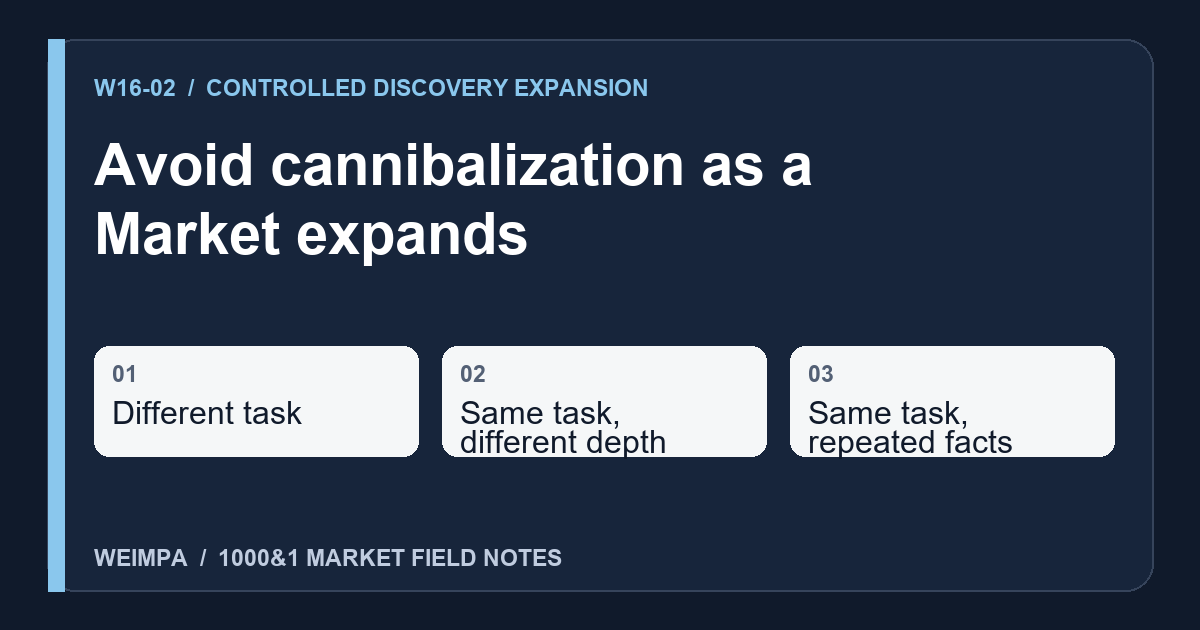
| Different task | retain both and link them clearly. |
| Same task, different depth | enrich the stronger route. |
| Same task, repeated facts | merge and redirect when public. |
- 01Different task
- 02Same task, different depth
- 03Same task, repeated facts
Choose one owner for a duplicated task
If the same reader would get essentially the same answer twice, strengthen one route and merge or redirect the other under the public site's normal process. In this 50-page wave, the W05 pages must keep distinct decisions despite shared market-map language. A similarity score can point to a review pair, but the editorial judgment depends on utility and intent.
Review W05 as a boundary case
The market-map data model, inclusion boundary, category taxonomy, participant eligibility, geography and rule revision pages share vocabulary. Each must still deliver a different decision: structure, scope, classification, entity ruling, territory or change control. Compare a sample reader task across these pages. If a section in two pages gives the same answer, shorten one and link to the other; preserve both URLs because the overarching tasks remain distinct. This is a more useful overlap check than counting repeated terms.
Text similarity does not decide intent
Do not treat a text similarity score as the final decision. The editorial test is whether one reader would need both pages to complete the task.
References and source notes
Original 1000&1 methodology reviewed and approved by the author. Public claims and historical measurements are bounded by the linked sources and dates.