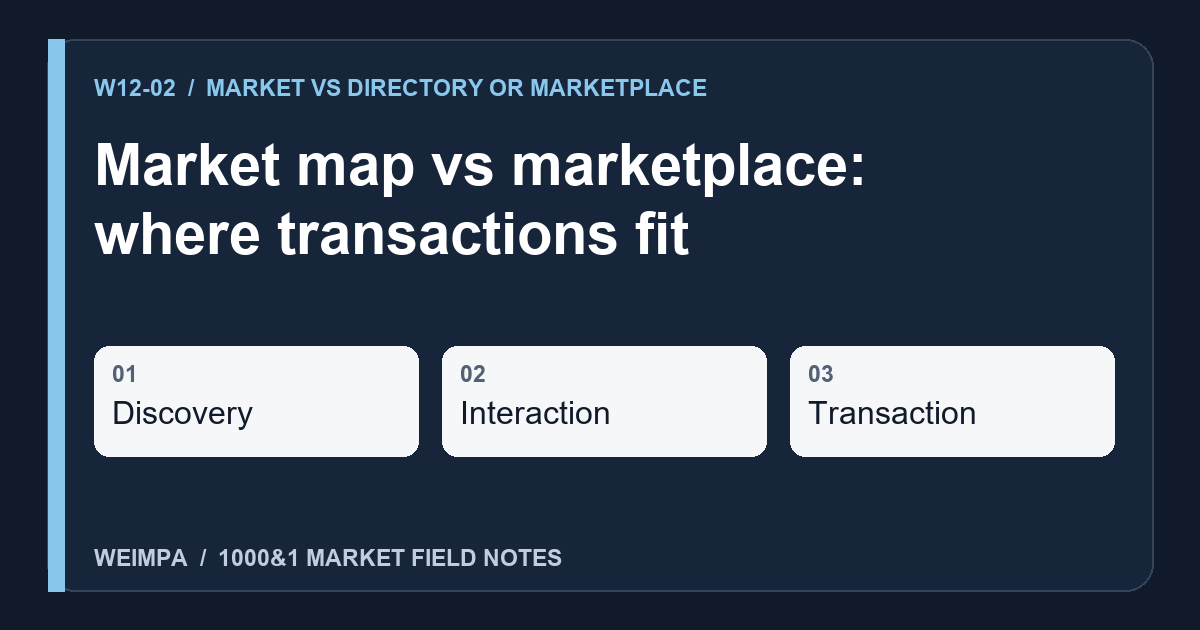
Discovery-to-transaction capability table
| Decision field | Record or rule |
|---|---|
| Discovery | find and understand alternatives. |
| Interaction | contact or compare a participant. |
| Transaction | purchase, payment or booking inside a platform. |
- 01Discovery
- 02Interaction
- 03Transaction
Locate the transaction boundary
A Market map helps a buyer discover and compare routes. A marketplace adds transactional roles such as offers, ordering, payment or fulfillment. Those are different product obligations. A profile link that sends a reader to a vendor does not turn the map itself into a marketplace.
- Write the user journey from discovery to final transaction.
- Mark the exact step the product itself controls.
- Separate information quality obligations from transaction or fulfillment obligations.
Do not infer capability from language
The public 1000&1 Market product describes research and maintained navigation. It does not claim to process buyer transactions. When evaluating a proposed product, list which steps occur on the Market, on a participant site and offline. That boundary clarifies the data model and the risk of promising a transaction flow the platform does not operate.
For the operating product behind this comparison, inspect the 1000&1 Market model.
Follow one buyer journey
A buyer reaches a Market category, compares source-backed participant profiles and leaves for the vendor's site to request a quote. The Market has supported discovery and evaluation. It has not processed the quote or transaction. If the proposal later adds ordering or payment, that requires new operational and legal capabilities. Map each step to its owner so the product description accurately reflects what happens. A link to an external checkout is not evidence that the Market itself is a marketplace.
The distinction can also guide what the operator measures. A Market can track discovery of categories and profiles; a marketplace must measure transaction steps and failures as its own service. Confusing the two can make a useful research product appear to promise outcomes it cannot observe or control.
A link is not a transaction
A contact link is not a marketplace checkout. Do not imply transaction protections that the product does not provide.
References and source notes
Original 1000&1 methodology reviewed and approved by the author. Public claims and historical measurements are bounded by the linked sources and dates.