Compare the operating obligations
A directory can identify businesses and links. A Market map adds explicit buyer tasks, category and role boundaries, source-backed relationships, freshness and correction practices. The distinction is visible in the work required to keep a comparison useful, not only in the page design.
- Compare the buyer task each product promises to support.
- Inspect the depth of structured relationships and source review.
- Ask who maintains records and how corrections change the public view.
Choose the lighter form when it fits
If a reader only needs contact details for a stable local list, a directory may be enough. If the decision requires comparing capabilities, routes and alternatives, a maintained Market structure is more appropriate. The public 1000&1 Market page describes the latter operating model. This comparison helps a buyer avoid paying for a data system when a simple directory would solve the actual task.
For the operating product behind this comparison, inspect the 1000&1 Market model.
Five-dimension operating comparison
| Decision field | Record or rule |
|---|---|
| Directory | retrieve and filter entries. |
| Market map | explain the structure of a commercial territory. |
| Decision layer | connect evidence to a bounded comparison. |
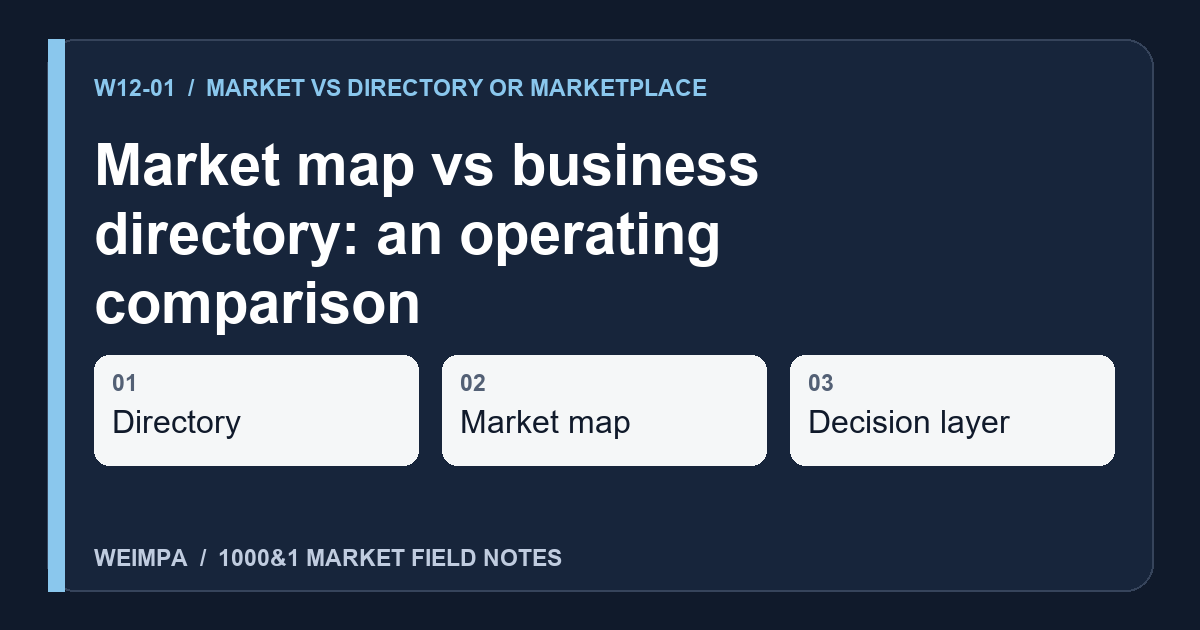
- 01Directory
- 02Market map
- 03Decision layer
Choose based on the buyer's work
If a reader only needs a list of local addresses, a directory may be the right product. If they need to understand competing routes, category fit, evidence quality and changes, a Market map offers more. The extra structure also has a cost: inclusion review and source maintenance. Compare both the reader benefit and the operator obligation before recommending a living Market. The distinction is an operating decision, not a judgment that every directory is low quality.
Use a directory when that is enough
A directory can be excellent for a narrow lookup task. Do not claim every Market is superior for every user or that any listed participant is endorsed.
References and source notes
Original 1000&1 methodology reviewed and approved by the author. Public claims and historical measurements are bounded by the linked sources and dates.