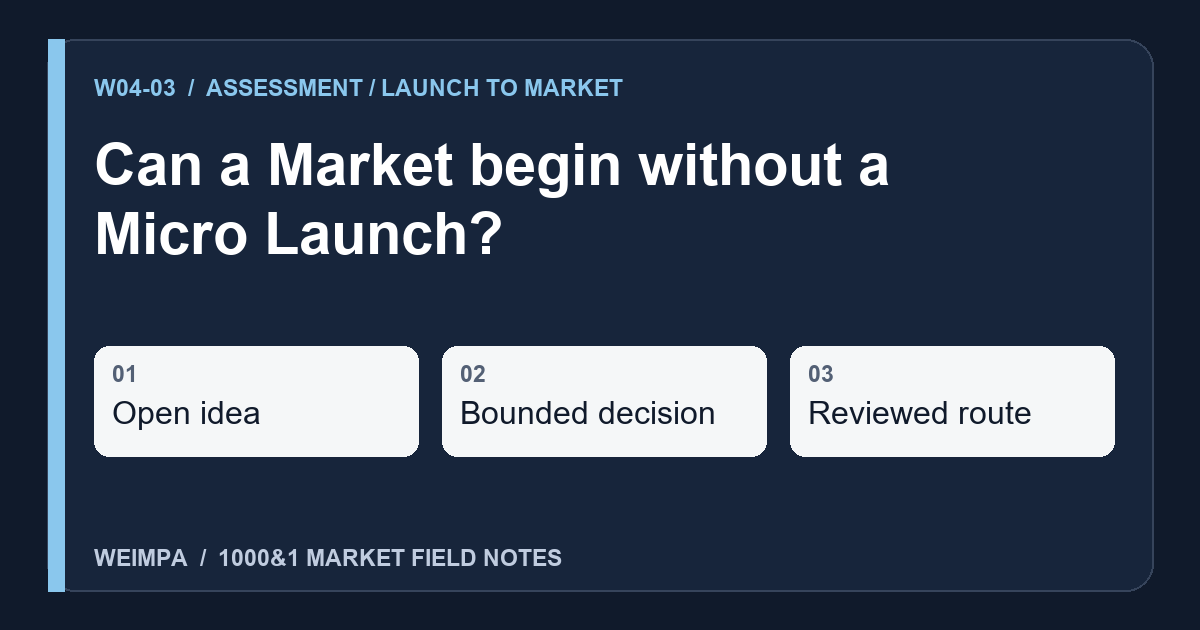
Route-choice decision tree
| Decision field | Record or rule |
|---|---|
| Open idea | first-pass check to find or reject a promising direction. |
| Bounded decision | Launch Case to compare alternatives and risk. |
| Reviewed route | Market build with an explicit evidence and upkeep contract. |
- 01Open idea
- 02Bounded decision
- 03Reviewed route
Select the route from the evidence state
An open idea needs a limited first pass. A bounded but uncertain commitment needs comparison and sensitivity. A reviewed direction with source and operating owners can proceed toward a Market. This is a decision tree, not a mandatory sequence of marketing pages. Inventory what the team already knows before buying or repeating work.
- Inventory existing research and ask what decision it actually supports.
- If the question is broad, run a limited opportunity check; if one decision remains, use a Launch Case.
- Build a Market only when scope, sources and operating owner are clear.
Keep the commercial contract distinct
The current 1000&1 Market page describes Launch Case as part of its commercial path, while Micro Launch is a first-pass option. Whether the free first pass helps a particular buyer is a separate question from the Market commitment. If a team bypasses that step, record the existing evidence and decision owner that make it unnecessary. Skipping a redundant exercise must not mean skipping validation.
Avoid a redundant first pass
A founder may already have a reviewed buyer task, source inventory and a decision owner. Repeating an exploratory Micro Launch can delay the more important comparison of routes and risks. Conversely, a founder with only an industry idea cannot skip directly to a large Market because the product page sounds attractive. The appropriate entry point follows the state of the evidence. Record what already exists, which decision remains open and the level of commitment contemplated. That record explains the route without implying that all buyers must follow the same sequence.
Skipping a step is not skipping validation
Skipping a first-pass exercise does not mean skipping validation. The buyer must still supply or commission evidence sufficient for the actual commitment.
References and source notes
Original 1000&1 methodology reviewed and approved by the author. Public claims and historical measurements are bounded by the linked sources and dates.