Treat geography as more than headquarters
Buyer location, provider location and service availability are different attributes. A company based in one country may serve another; a local provider may lack the exact capability a buyer needs. Define which geography controls inclusion and which only helps filter the map. Put restrictions and unknown coverage in explicit fields instead of inferring service reach from an address.
- Record the buyer's decision territory and the provider's actual service area separately.
- Test cross-border and online providers against the same availability rule.
- Add a local route only when locality changes the decision and is source-backed.
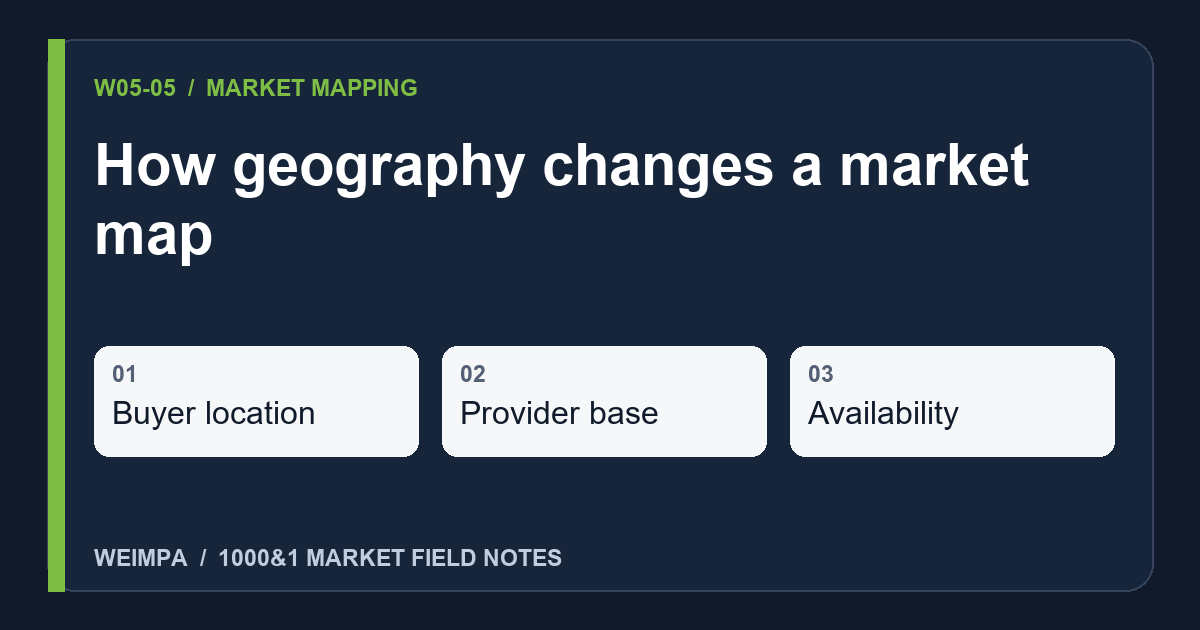
Geography rule table for buyer, provider and availability
| Decision field | Record or rule |
|---|---|
| Buyer location | where the problem and decision arise. |
| Provider base | where the organization is established, if relevant. |
| Availability | where the product or service can actually be used. |
- 01Buyer location
- 02Provider base
- 03Availability
Recheck when scope expands
A new country can change language, regulation, buyer alternatives and source quality. Reuse stable entity IDs where appropriate, but review availability and claims for the new territory. A geography filter that simply duplicates a global provider page adds little. The Market should expose a real difference in buyer choice or operating condition before a separate route is created.
To carry this decision forward, version the territory boundary.
Three geography fields, three answers
A provider headquartered in one country may serve buyers globally, but a regulated feature may be available only in selected markets. Store headquarters, buyer territory and service availability separately. A region-specific Market route should exist only if the territory changes the buyer's actual options or rules. Otherwise the same global provider list copied under local labels misleads readers. When availability is unknown, mark it as a verification task rather than inferring it from the corporate address or language of a website.
An address does not prove availability
Do not produce city or country permutations for coverage alone. If location does not change the answer, keep one useful page.
References and source notes
Original 1000&1 methodology reviewed and approved by the author. Public claims and historical measurements are bounded by the linked sources and dates.