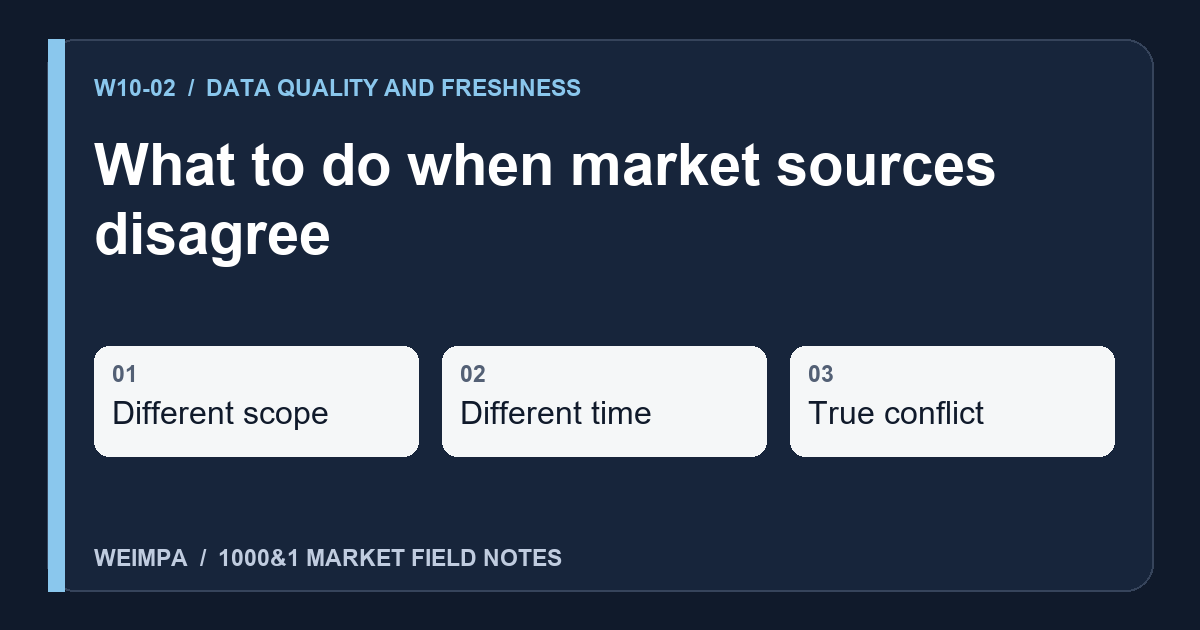
Resolution hierarchy and unresolved-state example
| Decision field | Record or rule |
|---|---|
| Different scope | two claims can both be true in different territories. |
| Different time | one source may be outdated rather than wrong. |
| True conflict | source disagreement remains unresolved after review. |
- 01Different scope
- 02Different time
- 03True conflict
Resolve the exact disagreement
Two pages may disagree because they use different dates, product versions or definitions. Capture both claims with URLs and timestamps, then ask whether they are truly contradictory. Prefer a primary source for the company's current claim, but do not treat it as independent validation of performance.
- Identify whether the sources discuss the same product, version, geography and date.
- Prefer the source with direct authority for that field, while preserving contrary evidence.
- Use cautious public wording or hold the claim if the conflict affects a decision.
Preserve unresolved states
If a vendor says a feature is supported and documentation is silent, the Market can report the vendor claim and mark verification pending. If two official sources conflict, hold the stronger buyer-facing assertion until the owner resolves it. A correction log should show what changed and why. Quietly choosing the more attractive statement would make future review harder.
A documented conflict example
One official page lists a capability; another current page omits it. The omission may be an abbreviated overview or a real withdrawal. Record both sources with capture dates and product version context. Do not choose the statement that makes the comparison grid look complete. Mark the capability disputed, ask the vendor or locate a release note, and keep the previous Market decision visible. The uncertainty is a useful buyer-facing fact until the conflict is resolved.
Unresolved conflicts must stay visible
Do not let a hierarchy become a blanket rule that official marketing claims prove outcomes. Authority depends on the type of fact.
References and source notes
Original 1000&1 methodology reviewed and approved by the author. Public claims and historical measurements are bounded by the linked sources and dates.