Count comparable options, not every logo
A dense category page may mix products, agencies, infrastructure and abandoned projects. First isolate a buyer job and a viable set of alternatives. Then examine differentiators, entry barriers, change rate and unmet constraints. Provider count is a context signal, not a saturation verdict.
- Segment the participant set by the same buyer problem and constraint.
- Compare differences that could change the buyer's choice.
- Look for unmet tasks and switching barriers before calling a gap an opportunity.
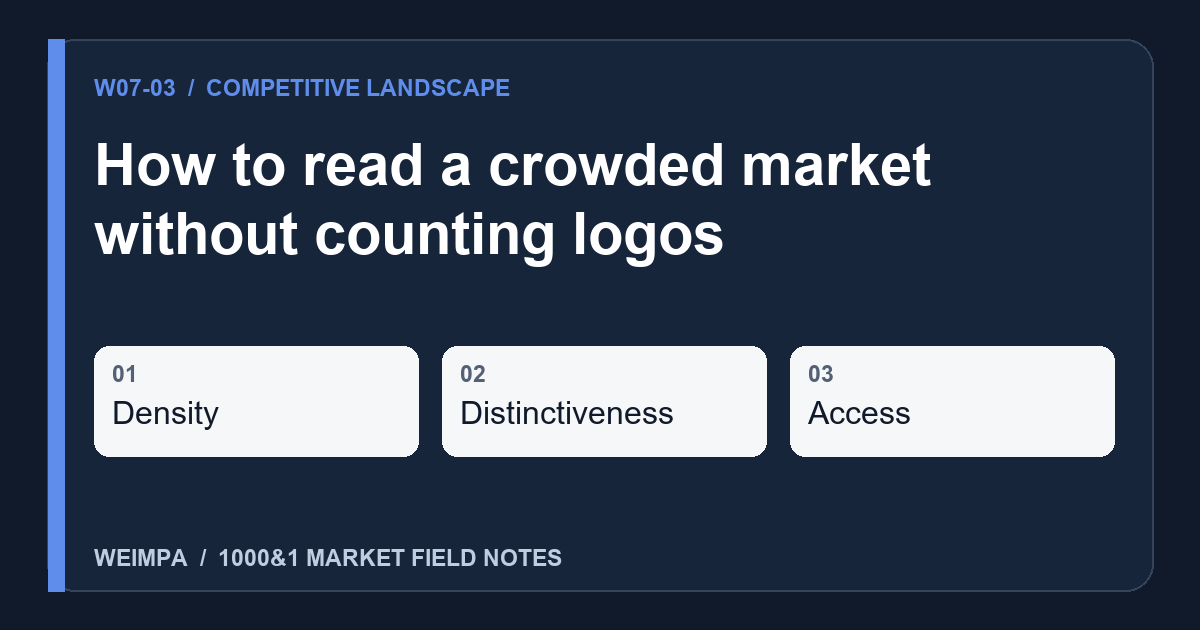
Crowding signal framework by buyer job and differentiation
| Decision field | Record or rule |
|---|---|
| Density | alternatives available for this task, not all categories. |
| Distinctiveness | observable differences in offer or delivery. |
| Access | how buyers currently discover and evaluate options. |
- 01Density
- 02Distinctiveness
- 03Access
Look for gaps in the comparison
If every visible product claims the same generic capability, inspect specific integration, geography or operating constraints that matter to the buyer. Search1001's multiple route axes demonstrate why crowding on one broad page may conceal a more useful narrow task. A gap is only an opportunity hypothesis until buyer evidence and feasible supply are checked.
To carry this decision forward, compare verifiable dimensions.
Test whether crowding is meaningful
A broad category may show many logos, but only a subset addresses the same buyer task and geography. Filter the set by actual substitution, then compare the source-backed differentiators. If most candidates make indistinguishable public claims, the opportunity may be to improve buyer information; if the available sources cannot support a useful comparison, a new Market route may not help. Saturation is a hypothesis about choice and differentiation, not the result of counting entries on a page.
Crowding is not a logo count
No public matrix proves that a new entrant can win. It identifies where a deeper buyer and economics test is needed.
References and source notes
Original 1000&1 methodology reviewed and approved by the author. Public claims and historical measurements are bounded by the linked sources and dates.