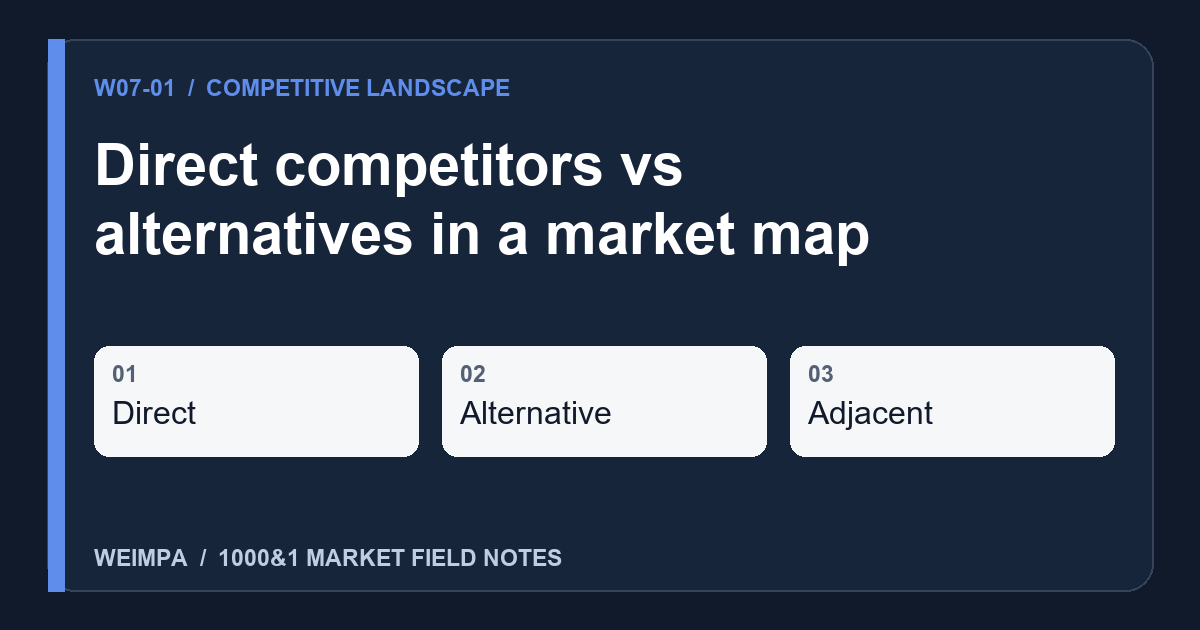
Substitution test matrix
| Decision field | Record or rule |
|---|---|
| Direct | same job and similar buying route. |
| Alternative | same job through a different mechanism. |
| Adjacent | overlaps a feature but not the core job. |
- 01Direct
- 02Alternative
- 03Adjacent
Test substitution from the buyer's task
Two firms are direct competitors only when a buyer could plausibly choose either for the same outcome under similar constraints. An alternative may solve the task through a different route, including internal work. Compare task, trigger, budget, implementation burden and outcome before placing logos in a competitive set.
- Define the buyer task and constraint before grouping providers.
- Test whether two offerings can substitute in the same decision moment.
- Mark partial or adjacent substitutions rather than forcing binary labels.
Keep the edge cases visible
Search1001's category and capability routes can surface products that share a capability but serve different primary jobs. A shared tag alone does not prove direct rivalry. Record why a participant is direct, indirect or only adjacent; change the label when a source or offering changes. The matrix is a decision aid, not a claim about private win rates.
To carry this decision forward, keep the Market map's roles clear; build the comparison grid.
Run a substitution interview
Ask a buyer what they would do if one proposed provider disappeared. If they would choose another product under the same budget and implementation constraints, the pair may be direct competitors. If they would build internally or change the workflow, those are alternatives that still matter to validation but belong in a different matrix row. Public category membership is only a starting clue. Record the actual job and constraint that make substitution plausible, and mark the buyer evidence separately from the analyst's inference.
A shared tag is not direct rivalry
Competitive sets are task-specific. Two firms can compete in one use case and complement each other in another.
References and source notes
Original 1000&1 methodology reviewed and approved by the author. Public claims and historical measurements are bounded by the linked sources and dates.